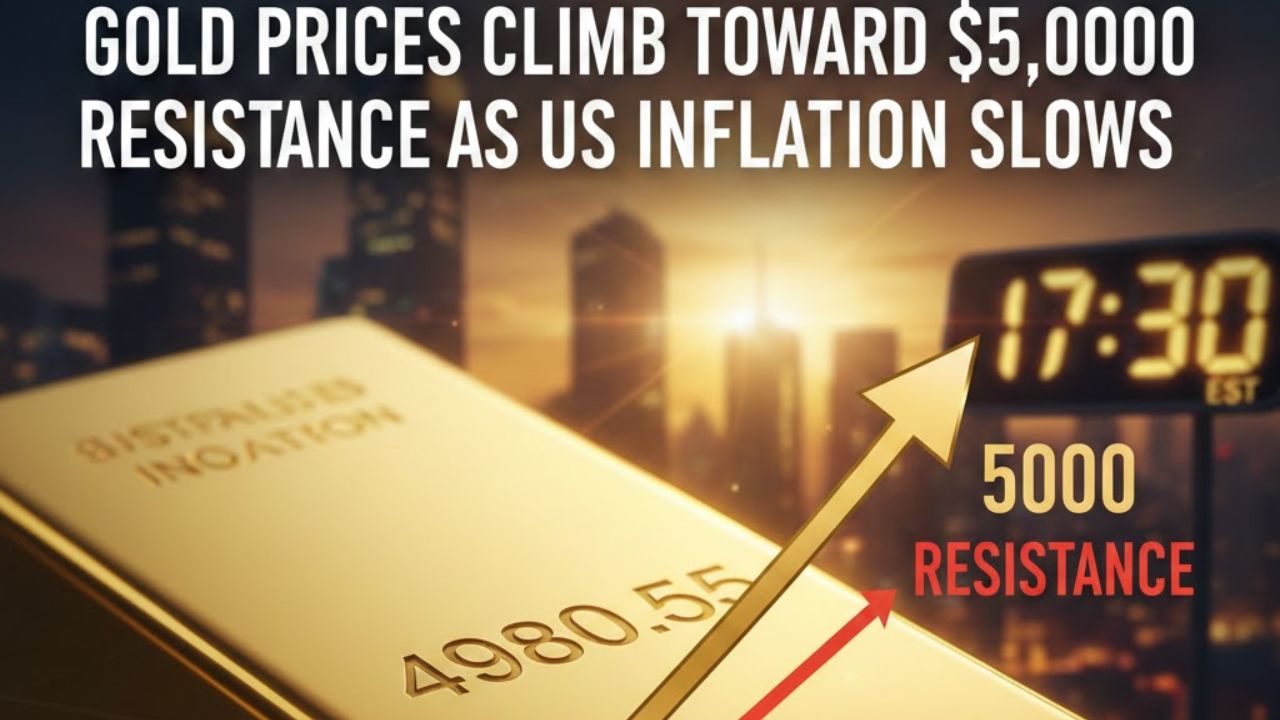
the global precious metals market is witnessing a historic tug-of-war as gold prices gravitate toward the significant $5,000 resistance level. This psychological and technical barrier has become the primary focus for institutional investors and retail traders alike. The recent surge is largely attributed to fresh economic data from the United States, which indicates that inflation is finally beginning to cool. As the U.S. Bureau of Labor Statistics reported January 2026 inflation at a slower-than-expected 2.4%, the “higher-for-longer” interest rate narrative has begun to fracture, providing a massive tailwind for non-yielding assets like bullion.
The Impact of Cooling US Inflation
The primary engine behind gold’s march toward $5,000 is the shifting landscape of American monetary policy. When inflation figures come in lower than projected, it signals to the Federal Reserve that the aggressive rate hikes of previous years have achieved their goal. For gold, this is a double-win: it weakens the US Dollar and lowers Treasury yields. Since gold is priced in dollars, a retreating Greenback makes the metal more affordable for international buyers, while lower yields reduce the opportunity cost of holding an asset that doesn’t pay a monthly dividend or interest.
Technical Resistance and the $5,000 Milestone
From a technical standpoint, the $5,000 mark is more than just a round number; it represents a major “line in the sand” for market bears. Throughout the latter half of 2025 and early 2026, gold has established a series of higher lows, creating a bullish wedge that points directly at this resistance. Analysts observe that while the path has not been linear—with occasional 2% to 3% “liquidity flushes” caused by profit-taking—the underlying structural demand remains incredibly resilient. If gold can secure a weekly close above $5,000, many Fibonacci extension models suggest the next target could sit as high as $5,400 or even $6,000 by the end of the year.
Comparative Performance: Gold vs. Economic Indicators (2025-2026)
| Period | Gold Spot Price (Avg) | US Inflation Rate (CPI) | Fed Funds Rate |
| Q1 2025 | $2,920 | 3.1% | 5.25% |
| Q3 2025 | $3,750 | 2.8% | 4.75% |
| Q1 2026 (Current) | $5,040 | 2.4% | 3.75% |
| Q4 2026 (Forecast) | $5,400+ | 2.1% (Est.) | 3.25% (Est.) |
Central Bank Accumulation and De-Dollarization
Beyond inflation data, a significant driver of the current price action is the aggressive gold-buying spree by global central banks. Nations such as China, India, and several Middle Eastern countries have been diversifying their reserves away from the US Dollar at a record pace. In fact, for the first time in decades, gold’s share of total global reserves has begun to rival that of US Treasuries. This institutional “floor” prevents the metal from experiencing deep corrections, as any minor dip is quickly met with massive buy orders from sovereign entities looking to hedge against geopolitical instability and currency debasementThe Role of Geopolitical Uncertainty
The world in 2026 remains a complex web of geopolitical tensions, from trade disputes in the Pacific to ongoing shifts in European security. Gold has historically thrived in such “risk-off” environments. Investors view the $5,000 level as a reflection of the global search for safety. When traditional equity markets or digital assets face volatility, capital flows back into the “old guard” of wealth preservation. The current rally isn’t just a speculative bubble; it is a calculated migration of capital toward an asset with zero counterparty risk.
Retail Demand and ETF Inflows
The narrative is also being supported by a resurgence in Gold Exchange-Traded Funds (ETFs) and physical retail demand. After a period of stagnation, Western investors are returning to gold ETFs in droves, with record inflows reported in the first quarter of 2026. This is being matched by an insatiable appetite for physical bars and coins in Asia. As the price nears the $5,000 threshold, the “fear of missing out” (FOMO) has started to settle in, potentially providing the final speculative push needed to break through the overhead resistance and establish a new trading range.
Market Outlook and Potential Risks
While the outlook is overwhelmingly bullish, the road to $5,000 is not without its hazards. A sudden reversal in inflation data or a surprise “hawkish” turn by the Federal Reserve could trigger a sharp correction toward the $4,800 support zone. Furthermore, extreme price levels often lead to “demand destruction” in the jewelry sector, particularly in price-sensitive markets like India. However, most experts agree that as long as real interest rates remain on a downward trajectory and central banks continue their accumulation, the momentum favors the bulls.
FAQs
Q1 Why is $5,000 considered a “resistance” level for gold?
Resistance levels are price points where selling pressure typically outweighs buying pressure. Because $5,000 is a major psychological milestone, many traders set “sell” orders at this level, which can cause the price to pause or pull back before it successfully breaks through.
Q2 How does slowing inflation help gold prices?
Slowing inflation suggests that the central bank may stop raising interest rates or begin cutting them. Lower interest rates make gold more attractive because it doesn’t offer a yield; when bank account interest is low, investors are more willing to hold gold for its potential value appreciation.
Q3 Could gold prices drop after hitting $5,000?
Yes. It is common for assets to experience “profit-taking” after hitting a major target. If gold reaches $5,000, some investors may sell to lock in their gains, which could cause a temporary dip before the market decides on its next long-term direction.
Disclaimer
The content is intended for informational purposes only. you can check the officially sources our aim is to provide accurate information to all users