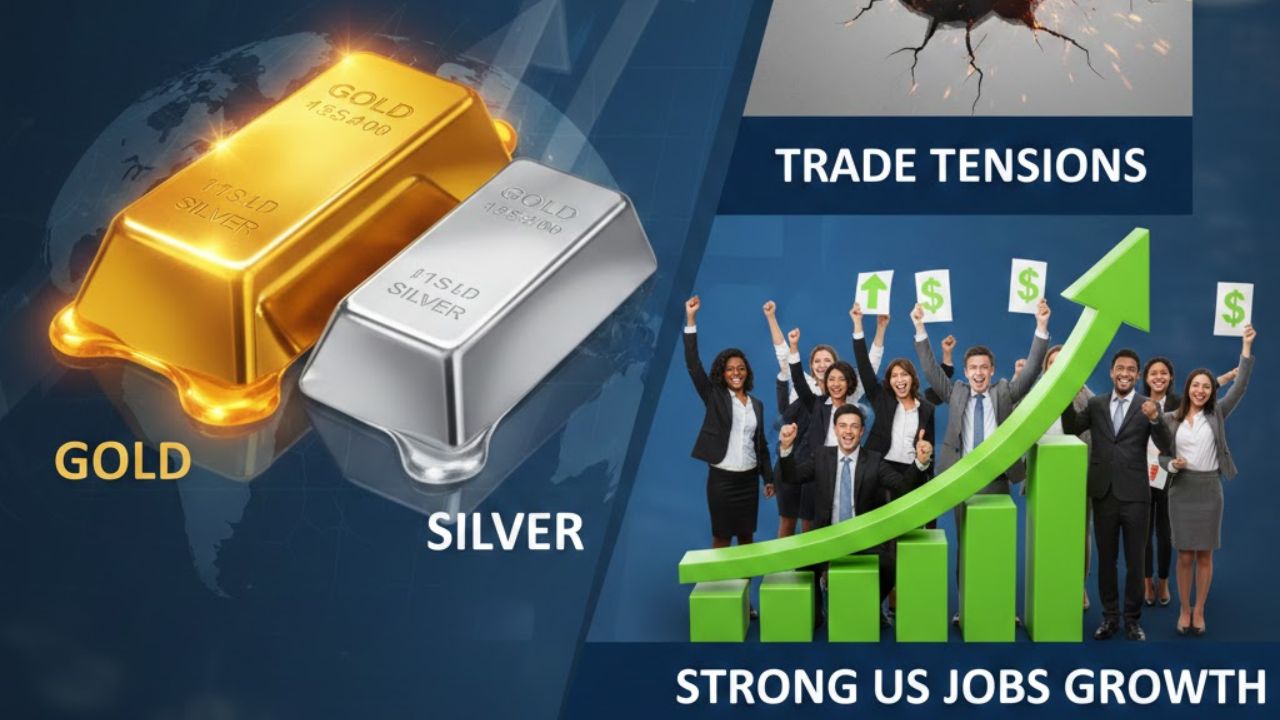
The global financial landscape in 2026 has been defined by a tug-of-war between safe-haven appeal and robust economic indicators. Recently, the precious metals market experienced a significant “reality check” as gold and silver prices recoiled from their historic peaks. This shift was primarily triggered by a double-whammy of exceptionally strong US labor market data and a hawkish shift in expectations regarding Federal Reserve policy. While the broader long-term trajectory for bullion remains underpinned by structural demand, the short-term outlook is now a complex puzzle of geopolitical friction and macroeconomic resilience. Investors are closely watching how these conflicting forces will dictate the next leg of the commodities cycle.
The Impact of Resilient US Employment Data
In mid-February 2026, the US Bureau of Labor Statistics released a January nonfarm payrolls report that caught the market completely off guard. The economy added a staggering 130,000 jobs, nearly doubling the consensus forecast of 70,000. Coupled with an unemployment rate that dipped to 4.3%, the data sent a clear signal: the American economy is far more resilient than previously feared. For gold and silver, this was a bearish development. Stronger employment reduces the pressure on the Federal Reserve to cut interest rates, causing the “higher-for-longer” narrative to resurface. Since gold and silver are non-yielding assets, they become less attractive when Treasury yields rise and the US dollar strengthens, leading to the sharp corrections observed recently where gold slipped back toward the $5,000 mark.
Trade Tensions as a Primary Bullish Driver
Despite the pressure from a strong dollar, trade tensions remain a potent catalyst for precious metals. The ongoing friction between the United States and major trading blocks over tariffs and “critical mineral” designations has fostered a climate of deep uncertainty. History shows that whenever global commerce is threatened by protectionist policies, investors flock to gold as a primary store of value. In 2026, the threat of retaliatory tariffs on electronics and renewable energy components has acted as a floor for prices. Even as the dollar gains strength, the fear of a fragmented global trade system keeps central banks and institutional investors on high alert, ensuring that any dip in price is met with strategic buying interest.
Key Market Indicators and Price Levels
To understand the current volatility, it is essential to look at the specific price points and economic markers that are governing trader behavior. The following table summarizes the recent shifts in the market:
| Asset / Indicator | Recent Price / Value | Weekly Change | Key Support Level |
| Spot Gold (Per Oz) | $4,981 | -2.3% | $4,900 |
| Spot Silver (Per Oz) | $76.53 | -9.1% | $74.00 |
| US Unemployment Rate | 4.3% | -0.1% | N/A |
| US Dollar Index (DXY) | 97.00 | +0.5% | 95.50 |
| Gold-Silver Ratio | 61:1 | Widened | 50:1 |
Silver’s Dual Role and Industrial Vulnerability
Silver is currently navigating a more volatile path than gold due to its dual identity as both a safe haven and an industrial metal. While gold is largely driven by currency shifts and central bank activity, silver is heavily tied to the manufacturing sector, particularly in solar energy and AI-driven data centers. The recent price crash—where silver futures plunged nearly 9% in a single day—highlights its sensitivity to economic shifts. While trade tensions can boost silver’s safe-haven status, the same tensions can disrupt the supply chains of the industries that consume it. This “double-edged sword” has led to a widening of the gold-silver ratio, suggesting that silver is currently undergoing a period of “froth-clearing” after its massive 141% rally in the previous year.
Central Bank Strategy and Long-term Support
A critical factor preventing a total collapse in bullion prices is the continued appetite from global central banks. Nations like China and India, along with several emerging markets, have maintained a steady pace of gold accumulation to diversify their reserves away from the US dollar. This structural demand provides a “hard floor” for gold prices regardless of short-term US economic data. In 2026, central banks are expected to purchase nearly 755 tonnes of gold, a figure that remains historically high. This institutional backing suggests that the current pullback is more of a healthy consolidation within a long-term bull market rather than the start of a sustained downtrend.
Technical Outlook and Investor Sentiment
From a technical perspective, the $5,000 level for gold has transitioned from a psychological ceiling to a contested battlefield. Analysts suggest that as long as gold holds above its 50-day moving average, the broader uptrend remains intact. For silver, the focus is on the $74 to $81 support band. Market sentiment is currently “neutral to cautious” as traders wait for upcoming inflation data to confirm if the Fed’s hawkish stance is justified. If inflation remains sticky while the labor market stays strong, the pressure on precious metals could persist. However, any flare-up in trade disputes or a sudden softening in economic data would likely reignite the rally, pushing gold back toward the $5,600 resistance zone.
Conclusion: Balancing Risk and Reward
The outlook for gold and silver in the remainder of 2026 is one of “managed volatility.” The era of easy gains driven solely by low interest rates has ended, replaced by a complex environment where investors must weigh the strength of the US economy against the fragility of global trade. While the recent jobs growth has provided a headwind, the underlying reasons for owning precious metals—geopolitical risk, debt concerns, and currency diversification—remain as relevant as ever. For the savvy investor, the current price correction may represent a strategic entry point, provided they can withstand the “noise” created by high-frequency economic data releases and shifting central bank rhetoric.
FAQs
Q1. Why did gold and silver prices crash despite ongoing trade tensions?
The crash was primarily driven by “better-than-expected” US jobs data, which strengthened the US dollar and reduced the likelihood of interest rate cuts. This economic strength temporarily overshadowed the safe-haven demand generated by trade tensions.
Q2. How do higher interest rates affect the price of gold?
Gold does not pay interest or dividends. When interest rates rise, investors can get better returns from bonds and savings accounts, making the “opportunity cost” of holding gold higher and usually leading to a drop in its price.
Q3. Is silver a better investment than gold right now?
Silver offers higher volatility and potential for greater percentage gains, especially given its role in green energy. However, it is also riskier and more prone to sharp declines during economic shifts compared to the relative stability of gold.
Disclaimer
The content is intended for informational purposes only. you can check the officially sources our aim is to provide accurate information to all users